Proposed state policy would generate up to $8.30 in benefits for every $1 invested
Contact: Alex Papali, Center for Economic Democracy and COWOP Coalition, alex@economicdemocracy.us, or Helen Matthews, Center for Economic Democracy, homefries@economicdemocracy.us
BOSTON, MA - Coalition for Worker Ownership and Power (COWOP) and Center for Economic Democracy today released a report showing Massachusetts can address a looming small business succession crisis at low cost by supporting the conversion of conventional businesses into worker-owned cooperatives. The report launches during a national gathering of the US Federation of Worker Cooperatives at Roxbury Community College this weekend, featured in a session this afternoon on policy supports for worker-ownership.
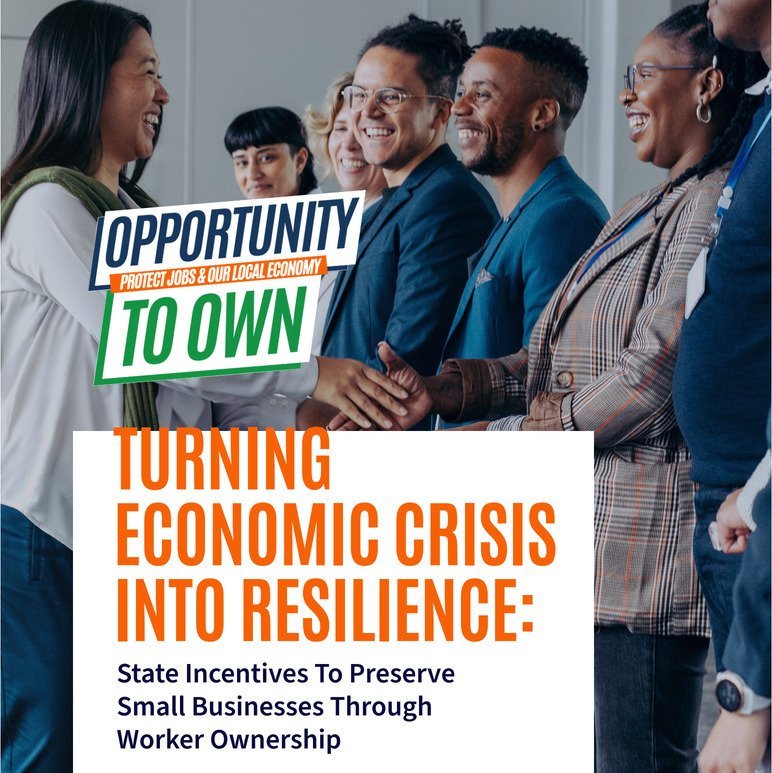
Turning Economic Crisis into Resilience: State Incentives to Preserve Small Businesses through Worker Ownership, documents a "Silver Tsunami" of closures driven by retiring owners who can't find a buyer - nationally, 3 out of 4 small businesses put up for sale never sell. In Massachusetts, this contributes to an estimated 96,000 lost jobs a year.
The report proposes a state policy called Opportunity to Own (OTO), which would exempt the first $1 million in capital gains for owners who sell to their employees. OTO would also give workers notice and a sufficient window to bid on a business before it's sold. It would be implemented through the existing Massachusetts Center for Employee Ownership, requiring no new agency.
Turning Economic Crisis into Resilience: State Incentives to Preserve Small Businesses through Worker Ownership, documents a "Silver Tsunami" of closures driven by retiring owners who can't find a buyer - nationally, 3 out of 4 small businesses put up for sale never sell. In Massachusetts, this contributes to an estimated 96,000 lost jobs a year.
The report proposes a state policy called Opportunity to Own (OTO), which would exempt the first $1 million in capital gains for owners who sell to their employees. OTO would also give workers notice and a sufficient window to bid on a business before it's sold. It would be implemented through the existing Massachusetts Center for Employee Ownership, requiring no new agency.
The report's fiscal analysis finds the policy highly cost-effective: every $1 in foregone state revenue returns up to $8.30 through reduced unemployment costs and retained income tax revenue. Pairing it with a state loan guarantee program, costing just $730,000 over ten years, would return more than 15:1, the report finds.
But right now, conversions to worker-ownership are bottle-necked, the report notes, by the absence of a structured mechanism for employees to initiate a buyout, insufficient financial incentives for owners to sell to their employees, and a lack of seller awareness about the option.
"Opportunity to Own is a rare win-win-win," said Alex Papali, Director of Regional Economies at the Center for Economic Democracy. "It gives owners a dignified exit, gives workers a real path to build wealth, and strengthens the bottom line for our communities and the Commonwealth."
The coalition is calling on the MA legislature to enact OTO in full during the 2027–28 session. The full report is available at OpportunityToOwn.org.
###
The Coalition for Worker Ownership and Power (COWOP) is a growing statewide network that aims to bring together worker co-ops and developers, grassroots organizations and labor unions, and funders and investors to resource and coordinate the advancement of a worker ownership movement across Massachusetts.